
How Green Power is Reshaping Global Supply Chains
The logistics industry is under increasing pressure to reduce emissions while maintaining efficiency and profitability. According to the International Energy Agency, transport accounts for a significant share of global CO₂ emissions, making it one of the most important sectors in the transition to cleaner energy.
But renewable energy in logistics is no longer a theoretical discussion. Companies across warehousing, road freight, shipping, and parcel delivery are already investing billions into solar energy, electric vehicles, sustainable fuels, and hydrogen technology.
This article explores how renewable energy is being used in logistics today, examines real-world case studies, and answers the most common questions businesses are asking about sustainable supply chains.

Why Is Renewable Energy Important in Logistics?
The logistics sector is responsible for a significant share of global greenhouse gas emissions. Transport alone accounts for a large percentage of worldwide carbon output, with road freight being one of the biggest contributors.
As governments introduce stricter environmental regulations and customers increasingly prioritise sustainable suppliers, logistics providers are under pressure to reduce their environmental impact.
Businesses face pressure from several directions:

Rising fuel costs
Environmental regulations
Customer sustainability requirements
Investor expectations
Net-zero commitments
For logistics providers, renewable energy offers opportunities to:
✓ Reduce operating costs
✓ Lower carbon emissions
✓ Improve energy security
✓ Future-proof operations
✓ Strengthen customer relationships
The key question is no longer whether logistics will become greener, but how quickly.
-
Background
DHL has committed to achieving net-zero emissions logistics by 2050 and has invested billions into reducing the environmental impact of its global operations. Through its sustainability strategy, the company is targeting improvements across road freight, air freight, warehousing, and last-mile delivery.
What Are They Doing?
DHL has focused on several key areas:
Expanding electric delivery vehicle fleets
Investing in Sustainable Aviation Fuel (SAF)
Increasing the use of renewable electricity
Constructing carbon-neutral logistics facilities
Developing low-emission transport solutions for customers
The company has also introduced GoGreen Plus, a service allowing customers to actively reduce the carbon footprint of their shipments through the use of sustainable fuels.
Why Does It Matter?
DHL's approach demonstrates that decarbonisation is not limited to one part of the supply chain. Instead, meaningful emissions reductions require improvements across transport, warehousing, and energy consumption.
Key Takeaway
Businesses do not need to replicate DHL's scale. The lesson is that sustainability works best when it becomes part of an overall business strategy rather than a standalone initiative.

What Types of Renewable Energy Are Being Used in Logistics?
-
Solar energy is currently one of the most widely adopted renewable technologies within logistics.
Large warehouse roofs provide ideal space for solar panel installations, allowing businesses to generate electricity directly on-site.
Solar energy can power:
Warehouse lighting
Material handling equipment
Office operations
Electric vehicle charging stations
Temperature-controlled storage facilities
Many modern distribution centres are now designed with solar generation as a core feature rather than an afterthought.
-
Wind power plays an increasingly important role in supplying renewable electricity to logistics operations.
While individual logistics companies may not install their own wind turbines, many purchase electricity from renewable energy providers that source power from wind farms.
This allows businesses to reduce emissions without major infrastructure investments.
Biofuels
Biofuels are helping bridge the gap where full electrification remains difficult.
Renewable diesel, biodiesel, and sustainable aviation fuels are becoming increasingly important for:
Long-haul trucking
Maritime shipping
Air freight operations
These fuels can often be used within existing transport networks while significantly reducing lifecycle emissions.
-
Many industry experts believe hydrogen could become one of the most important renewable energy sources for heavy freight transport.
Hydrogen fuel cells offer several advantages:
Fast refuelling times
Long operating ranges
Lower emissions
Reduced dependence on diesel
Major vehicle manufacturers and logistics providers continue investing heavily in hydrogen-powered transport solutions.

How Renewable Energy Is Transforming Warehousing
Warehouses are becoming far more than storage facilities.
Today's modern logistics hubs are increasingly operating as energy-generating assets.

Smart Warehouses
Advanced warehouse facilities now combine:
Solar power generation
Battery storage systems
Energy-efficient lighting
Automated systems
Electric vehicle charging infrastructure
These technologies help facilities consume less energy while generating a portion of their own power requirements.
Energy Independence
Imagine a warehouse that produces much of the electricity it needs to operate.
That vision is becoming reality.
By generating power on-site, logistics operators can reduce exposure to volatile energy prices and improve operational resilience during grid disruptions.
-
Background
Amazon operates hundreds of fulfilment and logistics facilities worldwide. With such a large footprint, energy consumption is one of the company's biggest operational challenges.
What Are They Doing?
Amazon has invested heavily in renewable energy projects, including:
Large-scale rooftop solar installations
Wind energy projects
Battery storage technologies
Electric delivery vehicle charging infrastructure
Many fulfilment centres are now designed with sustainability in mind from the construction stage.
Results
The renewable energy generated helps power warehouse operations, reduce reliance on traditional energy sources, and support the company's broader climate commitments.
For logistics operators, Amazon's strategy highlights how warehouse roofs can become valuable assets rather than unused space.
Key Takeaway
Even smaller warehouses can benefit from solar installations. Businesses do not need an Amazon-sized budget to generate meaningful energy savings over time.
The Rise of Electric Freight Transport
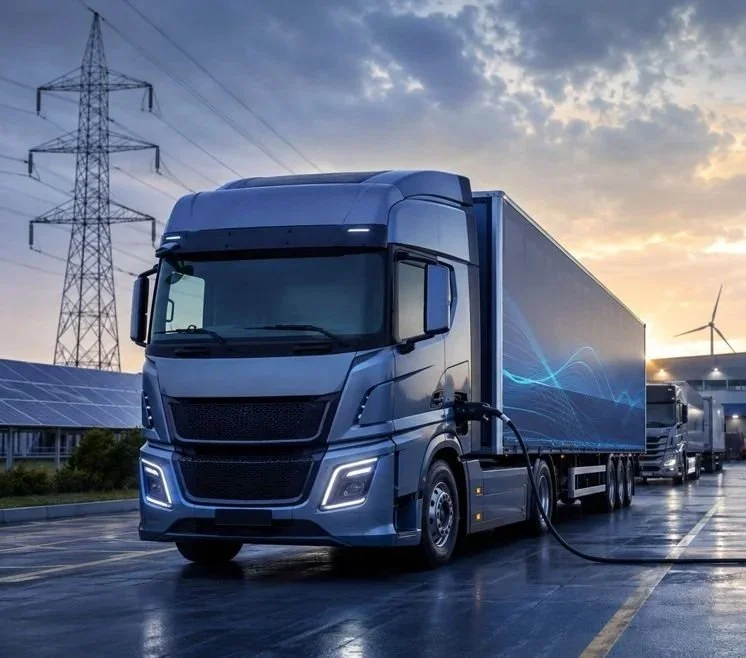
One of the biggest developments in logistics is the rapid growth of electric vehicles.
Electric vans have become increasingly common in last-mile delivery networks, particularly in urban areas.
However, improvements in battery technology are now enabling larger commercial vehicles to enter the market.
Benefits of Electric Freight Vehicles
Businesses adopting electric transport can benefit from:
Lower fuel costs
Reduced maintenance requirements
Lower emissions
Compliance with clean air zones
Improved sustainability credentials
While challenges remain around charging infrastructure and vehicle range, advancements continue to accelerate adoption.
-
Background
Parcel delivery companies face increasing pressure to reduce emissions, particularly in urban environments where air quality concerns are highest.
What Are They Doing?
UPS has invested heavily in:
Electric delivery vans
Alternative fuel vehicles
Charging infrastructure
Route optimisation technology
The company operates one of the largest alternative-fuel delivery fleets in the world.
Why Focus on Last-Mile Delivery?
The final stage of delivery is often the most emissions-intensive and expensive part of the logistics journey.
Electric vehicles are particularly effective because:
Routes are predictable
Distances are shorter
Vehicles return to depots daily for charging
Key Takeaway
Electrification may not yet be suitable for every freight movement, but it is proving highly effective in urban distribution networks.
Can Renewable Energy Reduce Logistics Costs?
One of the most common questions businesses ask is:
"Is renewable energy actually cheaper?"
The answer is increasingly yes.
Although renewable energy projects often require upfront investment, they frequently deliver long-term savings through:
Reduced electricity costs
Lower fuel expenditure
Decreased maintenance expenses
Tax incentives and grants
Protection from fuel price fluctuations
Many logistics companies now view renewable energy not only as an environmental initiative but as a commercial strategy.
Challenges Facing Renewable Energy Adoption
Despite significant progress, several obstacles remain.
-
Electric freight fleets require extensive charging networks.
Hydrogen-powered transport requires dedicated refuelling infrastructure.
These systems are still developing in many regions.
-
Renewable energy projects can involve substantial upfront expenditure.
Businesses must carefully evaluate return on investment and implementation timelines.
-
Certain solutions, particularly hydrogen-powered heavy transport, remain in the early stages of widespread commercial adoption.
As technology develops, costs are expected to continue falling.
What Does the Future of Renewable Logistics Look Like?
The future logistics network is likely to look very different from today's.
We can expect to see:
Fully electric urban delivery fleets
Solar-powered distribution centres
Hydrogen-powered long-haul trucks
Sustainable aviation fuels in air freight
Smart energy management systems
Increased use of battery storage technology
Companies investing in renewable energy today are positioning themselves to remain competitive in an increasingly sustainability-focused market.

Questions Every Business Should Be Asking
If your business imports, exports, or relies on regular freight movements, consider the following:
Is your supply chain prepared for future environmental regulations?
Do your logistics partners have a sustainability strategy?
Could renewable-powered warehousing reduce operating costs?
Are your customers increasingly asking about carbon emissions?
Could greener logistics strengthen your competitive advantage?
These questions are becoming increasingly important across every sector.

Final Thoughts
Renewable energy is no longer a future concept within logistics. It is already reshaping how goods are stored, transported, and delivered around the world.
From solar-powered warehouses and electric delivery fleets to hydrogen-powered freight vehicles and sustainable fuels, the industry is undergoing one of its most significant transformations in decades.
For businesses that depend on efficient supply chains, understanding these developments is becoming essential.
The logistics companies that embrace renewable energy today are likely to be the ones leading the industry tomorrow.
Call 01274 008082
🚢
Email Info@arcforwarding.com
✈️
Call 01274 008082 🚢 Email Info@arcforwarding.com ✈️
Sources
International Energy Agency (IEA) – Transport & Energy Reports
International Energy Agency (IEA)
DHL Sustainability Roadmap
DHL Sustainability Strategy & Roadmap
DHL Sustainability Reports
DHL Sustainability Reporting Centre
Amazon Sustainability Report
Amazon 2024 Sustainability Report
Amazon Sustainability Hub
Amazon Sustainability Overview
UPS Sustainability Reports
UPS Sustainability & Community Impact Reports
UPS Sustainability Strategy
UPS Sustainability Roadmap & Reporting
Maersk Decarbonisation Strategy